

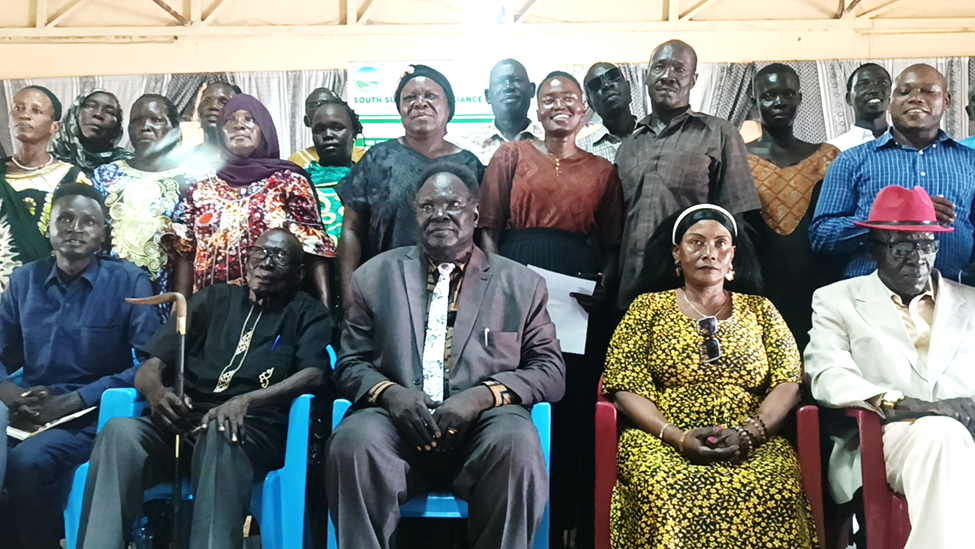
A group Photo by Awuou Michael Chol | during community dialogue at Rejaf | Juba County.
By Awuou Michael Chol
Some residents at Rajaf Payam, Juba County, are blaming persistent land-related conflicts on poor local leadership and weak administration. They called on the national government to urgently amend the country’s land policy.
The concerns were raised on Thursday, the 16th of April, 2026, during a land policy dialogue organized by South Sudan Land Alliance in Rajaf Payam.
Those in attendance highlighted widespread land grabbing and multiple allocations of the same plots, particularly in the Gumbo residential area. The complainants said some tokens are given at night to some powerful individuals.
A resident in attendance of the one-day community dialogue, Santina Juan Martin, attributed the problem to mismanagement within the local administration.
“Land grabbing in Gumbo is happening because of poor administration. Some officials are issuing land illegally in exchange for tokens,” she said.
For many unsatisfied residents like Juan, land ownership should follow proper legal procedures, and that would be greatly regulated by the delayed land policy.
“Land is everyone’s right regardless of who you are, but it must be acquired through the right and legal processes,” Juan added.
The South Sudan Land Act, 2009, is the primary legislation governing land tenure, management, and acquisition, establishing that all land is owned by the people and regulated by the government.
It classifies land into public, community, and private, allowing for formal registration and recognizing customary rights while facilitating legal acquisition for public interests, investment, and development
But some natives, like Christine Dudu Philip, suggested that the national government must fast-track amendments to the land policy, saying any delays continue to expose civilians to exploitation.
“The government must speed up the amendment process so that citizens are protected. I raised this issue with state leadership last year, but nothing has changed,” she said.
Local leaders also expressed frustration with the national legislature, accusing lawmakers of failing to address citizens’ concerns.
Joseph Akim Yokwe, a local chief, criticized parliamentarians for being disconnected from the people.
“Parliament is no longer checking on what is affecting the people” He said, “Many legislators are operating on orders and thinking of themselves only,” the chief stressed.
South Sudan Land Alliance is a body responsible for advocating for the rights of every person in a given community in the Country to acquire, own, and develop land.
Chaired by Dorothy Drabuga Ambrose, SSULA described the national land policy as a critical framework for resolving disputes and promoting development.
“A functional land policy provides an official framework to address land-related issues and conflicts. It also supports economic development through agriculture and infrastructure,” Drabuga explained.
Many have blamed the lawmakers for the delay in the land policy, who are responsible for tabling, deliberating, and passing the bill.
However, Deputy Chairperson of the Legal Affairs Committee at the National Legislative Assembly, Petro Juoj Machar, attributed the delay in amending the land policy to financial constraints.
The residents agreed to form a committee to engage with state authorities on land-related concerns.
The committee is expected to present community grievances and push for urgent reforms to address the ongoing land disputes.
Leave a Reply