

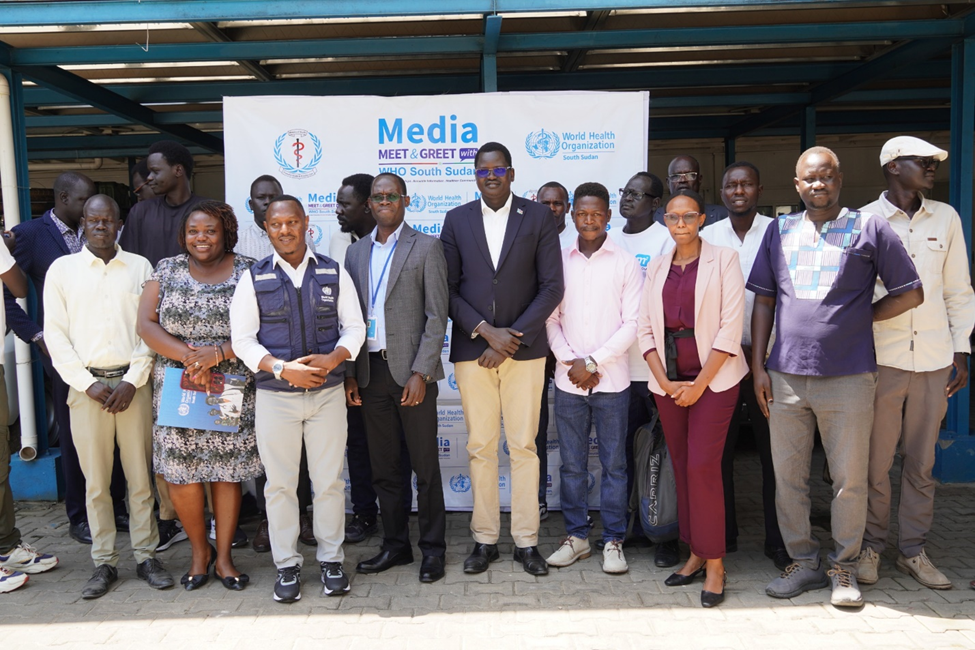
Group photo after the media engagement organized by the World Health Organization and the South Sudan Ministry of Health on 28th August 2026/ Photo credit: Ezekiel Idris
By Awuou Michael
Health authorities and the World Health Organization have called for increased investment in blood transfusion services in South Sudan, warning that timely access to safe blood remains critical in preventing avoidable deaths.
The call comes as health officials highlight the growing need for blood in emergency and routine medical care, particularly among women experiencing severe bleeding during childbirth, accident and trauma victims, severely malnourished children, malaria patients and people living with blood disorders.
Speaking during a media engagement in Juba, Dr. Angelo Aruop Akeen, Director of the National Blood Transfusion Service at the Ministry of Health, said blood transfusion is a critical and time-sensitive component of emergency healthcare.
“Blood transfusion is life-saving. It is one of the most important emergency requirements, especially for mothers who are giving birth and experiencing severe bleeding,” Dr. Akeen said.
He said the need for blood extends beyond maternal emergencies to patients suffering from severe anemia, trauma, malaria and chronic blood disorders.
Dr. Akeen recalled the death of a musician in 2021 following an accident, saying the case demonstrated the potentially fatal consequences of inadequate access to blood.
He called for greater public awareness and increased voluntary blood donation, urging communities to support blood transfusion services by becoming regular donors.
“We need the public to understand the importance of blood donation because whenever there is a shortage, patients are the ones who suffer,” Dr. Akeen said.
Bayo Pontius, WHO Technical Officer for Reproductive Health, said the country’s blood transfusion system faces gaps in infrastructure, cold-chain systems, equipment, trained personnel and voluntary blood donation.
He said voluntary, non-remunerated blood donation remains low, with estimates ranging from 7.6 to 34 percent, resulting in heavy reliance on family or replacement donors.
“We still have a situation where the country depends heavily on family replacement donors whenever patients need blood. This makes the supply unstable,” Pontius said.
Pontius said assessments conducted across the country have informed the National Blood Transfusion Services Strategic Plan 2026–2030, which provides a five-year roadmap for building a sustainable national blood transfusion system.
He said several interventions have already been implemented, including the procurement of 13 fully solar-powered blood-bank refrigerators covering ten states and three administrative areas.
WHO has also supported the provision of blood-bank equipment and supplies, as well as training for health workers in donor management, blood management, transfusion and administration.
“We have made progress, including the procurement of 13 solar-powered blood-bank refrigerators, but more needs to be done to ensure that these services are available and sustainable,” Pontius said.
He called for stronger government leadership, sustainable financing and greater coordination among national and state authorities.
Pontius also urged health workers and hospitals to strengthen the safe collection, testing, storage and appropriate clinical use of blood.
He called on communities, religious and traditional leaders, youth organizations, civil society and development partners to support voluntary blood donation and help address misconceptions surrounding blood donation.
“Government leadership and ownership are critical, but this cannot be the responsibility of government alone. Communities must donate, health workers must provide quality services, and partners must continue supporting the system,” he said.
Pontius further encouraged the media to play a stronger role in educating the public about the importance of blood donation and highlighting challenges affecting blood transfusion services.
He said WHO remains committed to working with the Ministry of Health, the National Blood Transfusion Service, state authorities, communities and development partners to build a sustainable, South Sudan-owned blood transfusion system.
The health officials emphasized that strengthening blood transfusion services is essential to reducing preventable deaths and ensuring that mothers, children, trauma victims and other critically ill patients receive safe blood when they need it.
South Sudan faces a severe nationwide shortage of safe blood, prompting the Ministry of Health and the World Health Organization to roll out the National Blood Transfusion Services Strategy for 2026–2030.
Leave a Reply