

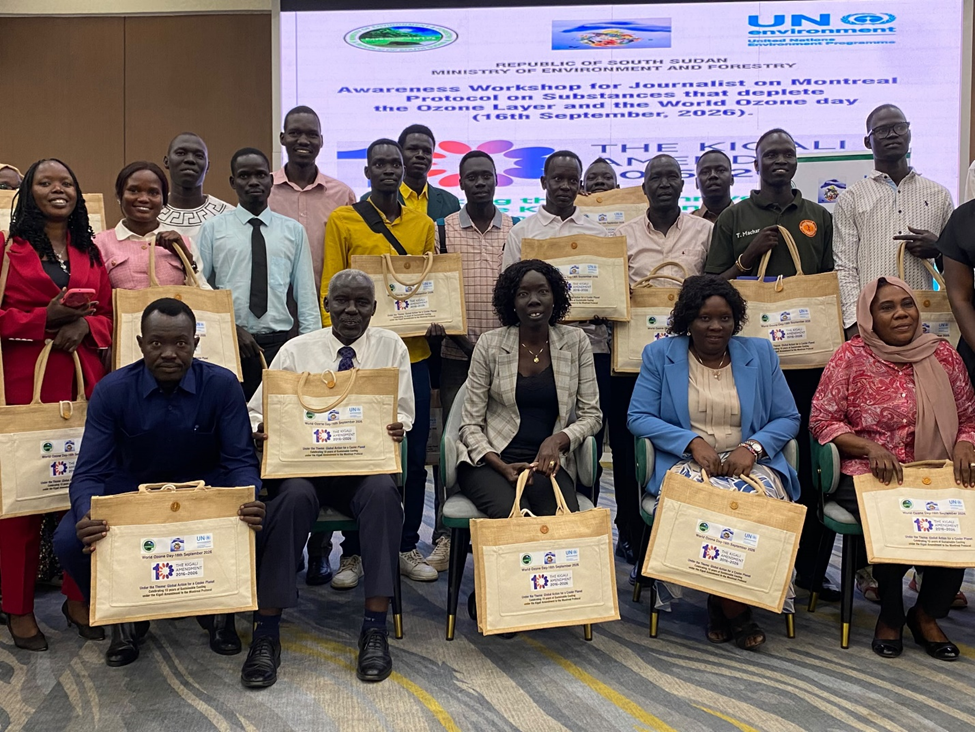
Journalists and officials from the National Ministry of Environment and Forestry posing for photo after a workshop for journalists on the Montreal Protocol in Dembesh Hotel in Juba on 11th September 2026
By Awuou Michael
South Sudan’s Ministry of Environment and Forestry says the lack of a strong legal framework is making it difficult to strengthen environmental protection and enforcement in the country.
Speaking at the close of a workshop for journalists on the Montreal Protocol ahead of World Ozone Day, Director General for Environment Education and Information Dorince Keji said key environmental laws were still awaiting enactment.
“The Environment Protection Bill and the Forest Bill remain under consideration and have not yet been passed into law,” Ms Keji said.
She said the absence of comprehensive legislation was affecting efforts to address environmental challenges and strengthen enforcement.
“The lack of a strong legal framework is one of the challenges affecting environmental protection in South Sudan,” Ms Keji said.
The director general also said South Sudan had not yet ratified the Kigali Amendment to the Montreal Protocol, which seeks to reduce the use of hydrofluorocarbons, or HFCs, that contribute to global warming.
She called for stronger environmental education and public awareness, particularly in schools and local communities.
“We need stronger public awareness and environmental education to help communities understand the importance of protecting the environment,” Ms Keji said.
Meanwhile the Acting Undersecretary in the Ministry of Environment and Forestry David Batali Oliver urged journalists to take a leading role in educating the public about ozone protection.
“Journalists have a responsibility to inform the public, promote accountability and draw policymakers’ attention to environmental issues,” Mr Oliver said.
He encouraged journalists to use investigative reporting, documentaries and public awareness programmes to explain the risks associated with ozone depletion.
“Journalists should become advocates and ambassadors for environmental protection,” Mr Oliver said.
He said about 90% of atmospheric ozone is found in the stratosphere, where it protects life by absorbing harmful ultraviolet radiation from the sun.
Mr Oliver said increased exposure to ultraviolet radiation could contribute to skin cancer, cataracts and weakened immunity, while also affecting crops, forests and marine ecosystems.
World Ozone Day is observed annually on 16 September to commemorate the adoption of the Montreal Protocol and promote international action to protect the ozone layer.
Leave a Reply