

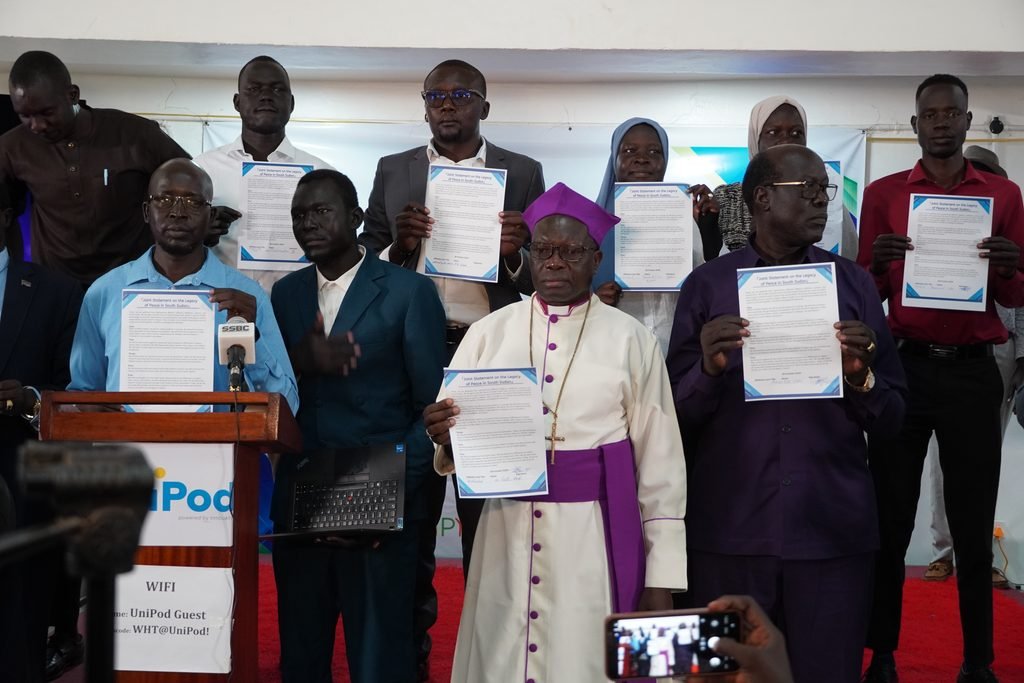
One South Sudan Peace Conference held at the University of Juba on 8/10/2026.Photo credit: Ezekiel Idris
By Ezekiel Idris
The One South Sudan Peace Conference has urged citizens to reject violence, overcome tribal and political divisions, and embrace peaceful coexistence to build a united and stable South Sudan.
The call was made during a peace conference, held under the theme “Beyond Our Camps, Bridging Our Future,” which brought together community, religious leaders, policymakers, youth, civil society organizations, and other stakeholders to discuss ways of strengthening peace and unity across the country.
Speaking at the conference, the Community Empowerment for Progress Organization (CEPO) Executive Director Edmund Yakani called on South Sudanese to rebuild trust and confidence in one another, warning that persistent divisions and mistrust continue to undermine peace and stability.
“We must choose peace and live in peace as one nation, South Sudan,” Yakani said.
He emphasized that every citizen has a responsibility to promote peace, regardless of their position or role in society.
Yakani also called on young people to reject divisive politics and participate in political activities that promote national unity and peaceful coexistence.
“We need to rebuild trust and confidence in one another because divisions and mistrust are hindering our progress towards peace and stability,” he said.
He further encouraged citizens to visit other communities and learn about their cultures and experiences, saying increased interaction could help dismantle stereotypes and strengthen relationships among South Sudanese.
Meanwhile, Jackline Nasiwa, Executive Director of the Center for Inclusive Governance, Peace and Justice, urged citizens to move beyond talking about peace and begin practising it in their daily lives.
Nasiwa said peace was not merely an aspiration but a necessity for survival, dignity, and the future of the country.
“Peace is not an abstract concept; it is essential for our survival, dignity, and the future of our nation,” she said.
She called on South Sudanese to dismantle barriers created by violence and build relationships that would allow future generations to inherit peace, justice, and hope.
Nasiwa warned that armed conflict has separated families, displaced communities, claimed lives, and destroyed livelihoods, leaving women and children vulnerable to gender-based and sexual violence.
“Our communities continue to suffer from violence, family separation, displacement, and the destruction of livelihoods,” she said.
She also expressed concern over what she described as weak implementation of peace agreements and national commitments, noting that violence continues in many communities while political differences remain an obstacle to lasting peace.
Nasiwa urged leaders and citizens to translate their commitments into practical action to address violence and build a peaceful society.
On his part, Deng Deng Hoc Yai, an associate professor at the University of Juba and former Minister of General Education and Instruction, said peace is fundamental to development, social mobility, and prosperity.
He stressed that maintaining peace is a collective responsibility shared by all citizens, not only politicians and members of the military.
“Peace is built through dialogue, understanding, and the willingness to choose love over hate,” Deng said.
He urged citizens to embrace kindness, avoid fighting, and serve others without discrimination based on tribal identity, adding that dialogue creates understanding, which in turn supports peace and development.
Deng also cited Article 46 of the Constitution, saying citizens have a responsibility to promote harmony, unity, fraternity, and tolerance.
“Every citizen has a responsibility to uphold peace and promote harmony, unity, fraternity, and tolerance,” he said.
He called on the government to maintain peace and security while investing in education and training for young people to encourage empathy, understanding, and respect for others.
Deng said children demonstrate how people can live together without tribal divisions, urging adults to learn from their example.
“Children do not see tribes; they see playmates and friends. We must learn from them and build a South Sudan where every child grows up without fear,” he said.
However Emmanuel William Atit, Secretary-General of the South Sudan National Youth Union, urged citizens to use their shared history of struggle for freedom and independence as a foundation for unity rather than division.
Atit said South Sudanese come from different communities, traditions, and experiences but share a common aspiration for peace, freedom, and a better future.
“Although we come from different community backgrounds, traditions, and experiences, we share a history of struggle for freedom, peace, independence, and hope,” Atit said.
He urged citizens to choose dialogue over division, arguing that the country’s shared history should bring people together despite their differences.
“Our history of struggle and independence should unite us more than divide us,” he said.
Atit also called on young people to become bridges of peace by engaging with people from different backgrounds, listening to their experiences, respecting their differences, and building friendships beyond community boundaries.
He said youth could use schools, communities, social media, and news organizations to spread messages of peace and influence positive change.
“South Sudan can become a peaceful and united nation where people live, work, travel, and enjoy freedom and equality in dignity and harmony when we choose peace over violence,” he said.
The One South Sudan Peace Conference was organized by Heavenly Culture, World Peace, Restoration of Light (HWPL), in collaboration with other peace actors, to encourage citizens to break down barriers of violence and work towards a peaceful and united nation
Leave a Reply