

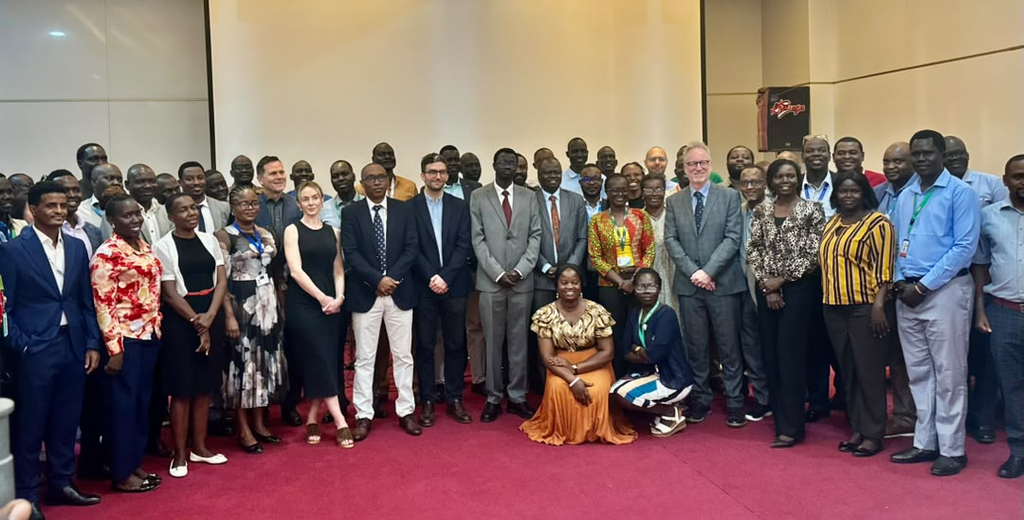
Group Photo taken during the Community Resilience Partnership learning event in Juba, 12th November 2026
By Awuou Michael
The United Kingdom, the United Nations World Food Programme (WFP) and the South Sudan government have called for stronger partnerships and sustainable investments to help vulnerable communities overcome food insecurity, climate shocks and economic challenges.
The call was made on Thursday during the Community Resilience Partnership learning event in Juba, which brought together government officials, development partners, UN agencies, civil society organisations and representatives of local communities to discuss practical approaches to strengthening resilience and self-reliance.
Speaking during the opening remarks, Duncan Overfield, Deputy Development Director at the British Embassy in South Sudan, announced an additional 2.35 million pounds in UK support for resilience and anticipatory action programmes implemented through Thrive, WFP and the Food and Agriculture Organization (FAO).
Overfield said the funding would strengthen efforts to help vulnerable households diversify their livelihoods, establish businesses, improve access to markets and prepare for future crises.
He highlighted the worsening food insecurity situation in the country, saying an estimated 7.8 million people are facing high levels of acute food insecurity, representing 58 per cent of South Sudan’s population, while more than two million children are acutely malnourished.
“2026 has seen food insecurity deteriorate from an already low baseline,” Overfield said.
He stressed that building resilience requires more than providing emergency assistance, adding that communities need sustainable opportunities to improve their livelihoods.
“Resilience is not just about surviving the next crisis. It is about building the foundations for long-term sustainable development,” he said.
Overfield also emphasised the importance of supporting local organisations and private-sector actors, saying their involvement is essential in strengthening communities and creating sustainable economic opportunities.
“There is no single blueprint for success in fragile environments. What works in one community may not work in another,” he added.
Meanwhile, Thomas Deville, Deputy Head of Programme at WFP South Sudan, called for a shift from short-term humanitarian interventions towards strategic partnerships that combine resources and expertise to support vulnerable communities.
Deville said the partnership with Thrive reflects WFP’s commitment to building long-term resilience and reducing communities’ dependence on repeated humanitarian assistance.
“We want to move away from purely transactional partnerships, and we want to keep building these kind of strategic partnerships,” he said.
He disclosed that UK funding through the Foreign, Commonwealth and Development Office (FCDO) had enabled WFP to provide food assistance to more than one million people this year while supporting programmes aimed at strengthening resilience and self-reliance.
However, Deville cautioned that self-reliance should not be interpreted as withdrawing humanitarian assistance before communities are ready.
“Our ambition is to expand the choices of the people that we serve, protect their dignity, and strengthen their ability to withstand the next shock,” he said.
He added that WFP was working with FAO and other partners on anticipatory action initiatives designed to ensure communities receive support before disasters strike.
“We also started working with the FAO and FCDO on anticipatory action. We try to act before a disaster strikes,” Deville said.
For his part, Moris Aduol Dut, Undersecretary at the Ministry of Agriculture and Food Security, called for stronger cooperation between the government, development partners, farmers and local communities to improve agricultural production and food security.
Dut said the learning event provides an opportunity for stakeholders to assess ongoing interventions, identify challenges and establish practical approaches that can be sustained and expanded.
Addressing development partners, he emphasised the importance of listening to communities and evaluating whether assistance is reaching intended beneficiaries.
“You know whether support arrived when it was needed. You know whether the service remains available,” Dut said, referring to the experiences of local communities.
He said resilience has different meanings for different groups, particularly farmers, women, young people and households affected by economic difficulties.
“For farming households, it may mean having enough food while waiting for the next harvest. It may mean keeping seeds for the coming season instead of consuming them during difficult periods,” he said.
The Undersecretary urged participants to use the gathering to identify effective interventions and address weaknesses in existing programmes.
“We should leave this event with greater clarity about what works for whom, under which conditions and at what cost,” Dut said.
He added that stakeholders should also be prepared to acknowledge shortcomings and make necessary adjustments to improve service delivery.
The Community Resilience Partnership brings together government institutions, humanitarian agencies and development partners to strengthen coordination, promote sustainable livelihoods and support communities affected by conflict, displacement, flooding and climate-related shocks.
The discussions are expected to provide lessons and practical recommendations for improving resilience programming and strengthening the capacity of South Sudanese communities to withstand future crises.
Leave a Reply