
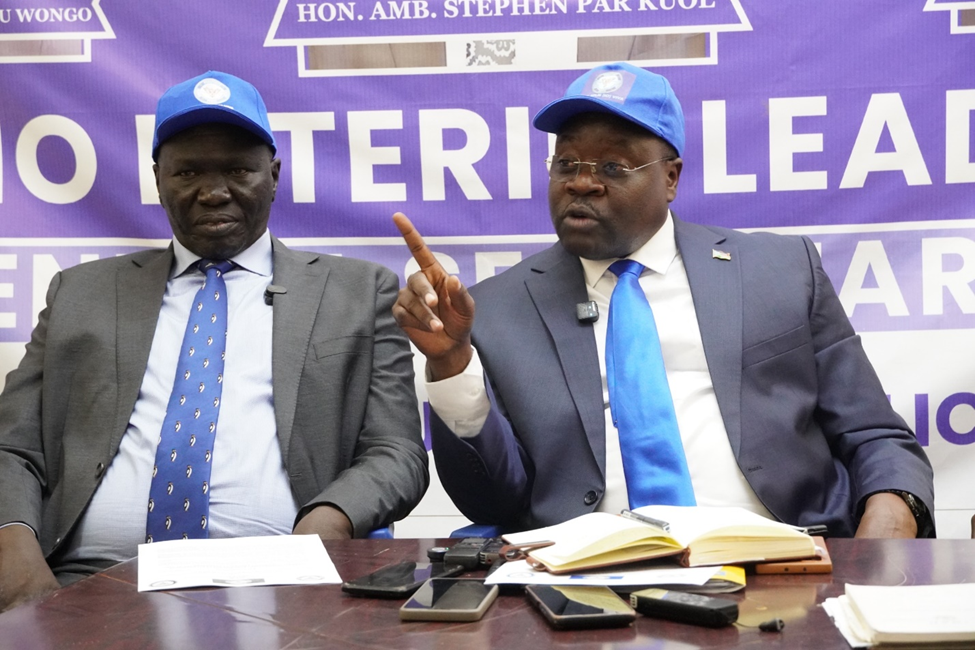
The Sudan People’s Liberation Movement-in-Opposition (SPLM-IO) interim Deputy Chairperson, Losuba Ludora Wongo (pictured Right), Interim Secretary General Agok Makur Kur (Pictured left) during a press conference in Juba on 20th, November 2026. Photo credit: Ezekiel Idris
By Awuou Michael
The Sudan People’s Liberation Movement-in-Opposition (SPLM-IO) has rejected the National Election Commission’s revised electoral timetable, insisting that any changes to the December 22, 2026, election date must be agreed upon through consultations with parties to the Revitalised Peace Agreement.
The party’s interim Deputy Chairperson, Losuba Ludora Wongo, made the position clear on Friday while addressing journalists in Juba, describing the commission’s decision to move the elections to February 11, 2027, as unilateral, deceptive and unlawful.
Wongo said the party believes the commission has no authority to alter the agreed electoral calendar without following the relevant constitutional and legal procedures.
“The SPLM-IO therefore categorically rejects the National Election Commission’s decision to change the South Sudan general election from the original date of December 22, 2026,” Wongo said.
He argued that the Electoral Act provides for postponement only under specific circumstances, including an imminent danger that makes voting impossible or the declaration of a state of emergency.
“So far, there is no imminent threat or any declaration of a state of emergency that can justify any alteration of the set election date,” he said.
The opposition official stressed that the party is not against holding elections but wants the process to comply with the law and produce a legitimate government through the democratic choice of citizens.
“We are not rejecting that we don’t want elections. We wanted to ensure that we have the rule of law,” Wongo said.
He further argued that the National Election Commission should have engaged the signatories to the peace agreement before making changes to the electoral timetable.
“The National Election Commission cannot act independently because it was reconstituted under the terms of the Revitalised Agreement,” he said.
Wongo maintained that if the commission faces challenges in conducting elections on the original date, it should explain those difficulties to the political parties and seek their views on the way forward.
On voter registration, Wongo encouraged South Sudanese citizens, regardless of their political affiliations, to participate in the ongoing exercise, saying it remains an important part of the electoral process.
“The most important activity that we are actually encouraging every South Sudanese, regardless of the parties, is that all of us must go and register,” he said.
The SPLM-IO has called on President Salva Kiir Mayardit to initiate an urgent and inclusive political dialogue involving all parties to the Revitalised Agreement, the National Election Commission, the Political Parties Council and other relevant institutions.
According to Wongo, the proposed dialogue should address electoral preparedness, political party financing, security arrangements, political freedoms, voter registration and restrictions on the movement of current and former government officials.
The party has also warned that it could reconsider its participation in the electoral process if outstanding legal, political and operational concerns remain unresolved.
Wongo said the opposition would not support an election that lacks adequate preparations or a clear legal foundation.
“The SPLM-IO will not endorse or participate in an electoral exercise that is inadequately prepared, legally questionable or incapable of producing legitimate democratic outcomes,” he said.
The party has further appealed to regional and international guarantors of the peace agreement, particularly IGAD, the African Union and the United Nations, to continue supporting the implementation of the agreement and South Sudan’s democratic transition.
The National Election Commission recently revised the electoral calendar, moving the planned general elections from December 22, 2026, to February 11, 2027, citing the need for more preparation time. The decision has sparked fresh debate among political stakeholders over the legal basis for the revised timetable and the country’s readiness to conduct its first general elections since independence.
Leave a Reply