
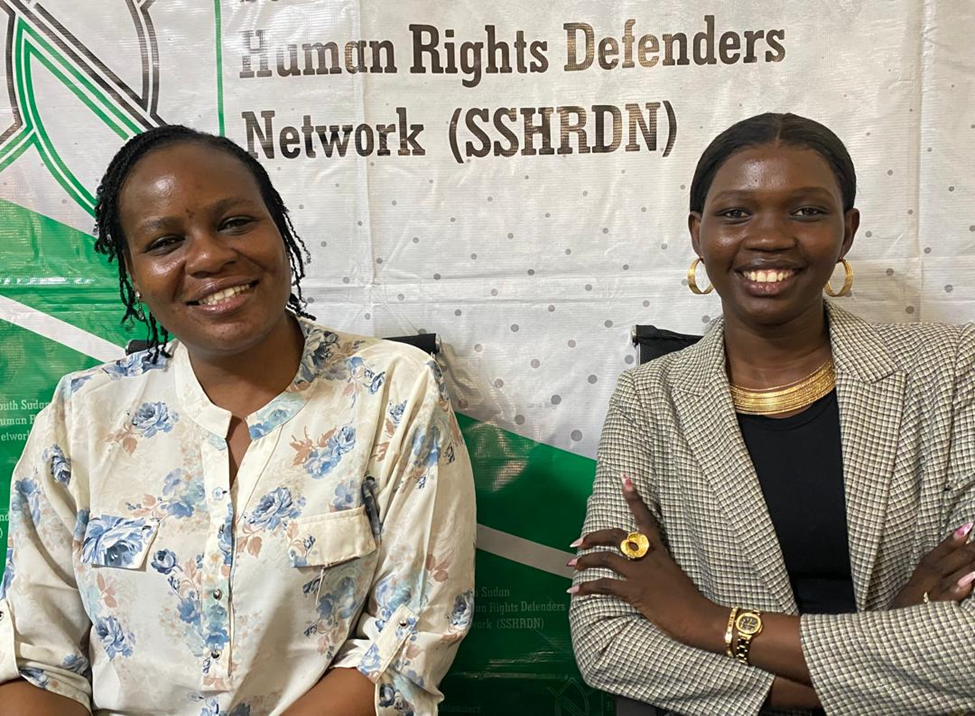
Adut Andrew, Administrative Assistant, South Sudan Human Rights Defenders Network (SSHRDN), pictured (Right); Gisma Magara, a Women Protection Officer at the South Sudan Human Rights Defenders Network, pictured (left) during a press conference in Juba on 24th November 2026
By Awuou Michael
The South Sudan Human Rights Defenders Network is demanding stronger action against perpetrators of sexual violence, as a new protection strategy reveals that rape and gang rape accounted for 81 per cent of documented conflict-related sexual violence incidents in 2025.
The call was made on Tuesday in Juba by the network’s Administrative Assistant, Adut Andrew, during a media briefing ahead of the 2026 16 Days of Activism Against Gender-Based Violence, where she highlighted the alarming scale of sexual violence and the urgent need to strengthen protection and justice mechanisms for survivors.
According to the 2026–2027 South Sudan Humanitarian Country Team Protection Strategy, rape accounted for 51 per cent of documented conflict-related sexual violence incidents, while gang rape represented 30 per cent.
Ms Andrew also expressed concern over gaps in survivor support, noting that only 64 per cent of documented survivors received urgent medical assistance, while just 26 per cent accessed psychosocial support.
She said survivors continue to face major obstacles in accessing justice, including financial difficulties, limited access to legal representation, fear and a lack of confidence in the justice system.
“Following up a case is financially challenging. If you don’t have financial stability, it will be very difficult for you to go to court, pay for a lawyer and cover transportation,” Andrew said.
Ms Andrew explained that the network works with partner organisations to refer survivors for assistance and called on victims to come forward and seek protection.
“We are ready to help, but we need the survivor to come out and say, I have experienced one, two, three, and I need protection and I need help, so that justice can be served accordingly,” she said.
She also urged society to recognise that gender-based violence affects both men and women, saying harmful cultural beliefs often discourage male survivors from reporting abuse.
“When we talk about gender, it is for both men and women,” Andrew said, calling for an end to harmful cultural practices that prevent survivors from speaking out.
Meanwhile, Gisma Magara, a Women Protection Officer at the South Sudan Human Rights Defenders Network, said the 16 Days of Activism campaign should be treated as a collective responsibility rather than an event for civil society organisations alone.
She said the campaign is particularly important for South Sudan because of the high levels of conflict-related sexual violence and forced marriages.
“For South Sudan, 16 Days of Activism means more than just an international campaign, but it is a call for collective action, responsibility and commitment,” Magara said.
Magara identified harmful cultural practices as one of the major obstacles preventing survivors from reporting sexual violence, explaining that some cases are settled at the family level through the payment of dowry or cattle.
“Sometimes the survivors are not able to come out, or sometimes the cases will be settled at the family level, especially when the person is able to pay the dowry or cattle money,” she said.
She also raised concern over the shortage of safe houses, saying survivors need secure spaces where they can receive protection without intimidation or interference from family members.
“We have challenges with safe houses where you can keep the survivors, where it will not be accessible to their family members,” Magara added.
The Women Protection Officer further explained that the network focuses on advocacy, capacity building, protection and research, while working with member organisations that directly handle cases involving survivors of gender-based violence.
She said the network also engages relevant government institutions to promote accountability and justice, while maintaining confidentiality in handling sensitive cases.
Magara urged the government, civil society organisations, development partners and communities to work together to end violence against women and girls.
She emphasised the need to build a society where women and girls can live without discrimination, fear or intimidation, both online and offline.
The network is also calling for stronger protection of women human rights defenders and activists, who frequently face threats, harassment and intimidation because of their work promoting equality and justice.
This year’s 16 Days of Activism Against Gender-Based Violence will run from November 25 to December 10 under the theme, “Unite to End Violence against Women and Girls, Ensure Justice, Protect Survivors, End Impunity.”
Leave a Reply