

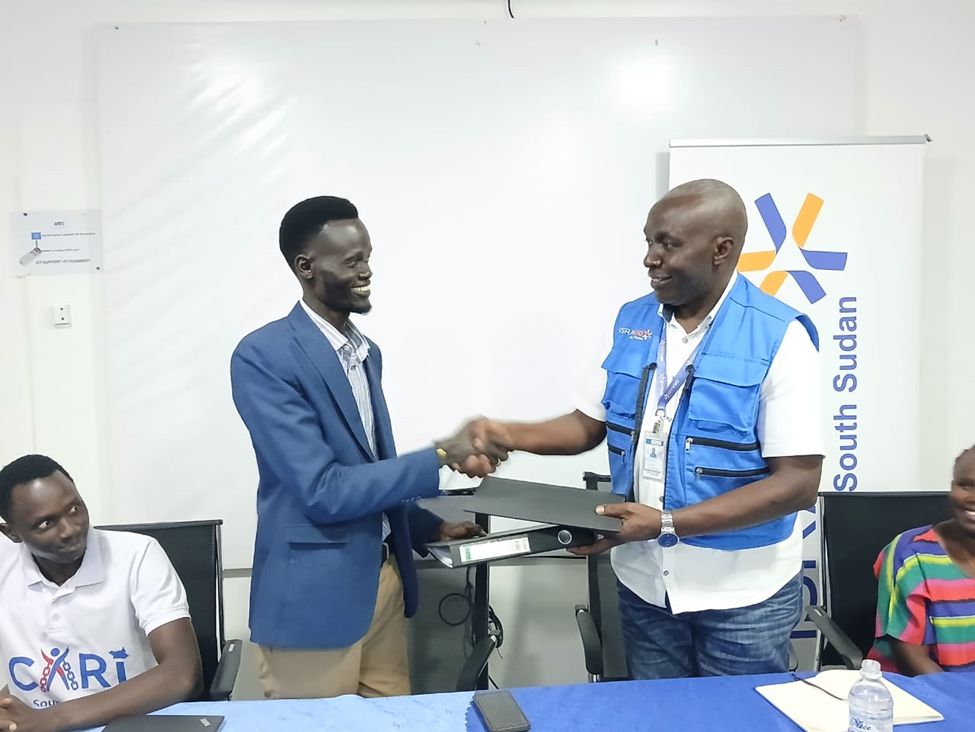
IsrAAID Country Director Thomas Okollah (pictured right) and CARI Executive Director Johnson Nguanyiet (pictured left) during the signing of a Memorandum of Understanding (MoU) between the two organisations in Juba on Friday, 13 November 2026; Photo Credit: Yuang
By Awuou Michael
IsrAAID South Sudan has set aside 280 million South Sudanese Pounds to support a local non-governmental organisation, the Community Actions and Resilience Initiative (CARI), following the handover of humanitarian project management responsibilities in Juba’s Internally Displaced Persons (IDP) Camps One and Three.
The three-month funding commitment was announced on Friday during the signing of a Memorandum of Understanding (MoU) between IsrAAID and CARI, marking a transition towards locally managed humanitarian interventions in the camps.
Speaking during the ceremony, IsrAAID Country Director Thomas Okollah said the handover reflects the organisation’s commitment to localisation, strengthening local capacity and ensuring the sustainability of humanitarian services.
“Today is a very auspicious occasion for us to hand over, basically, officially sign the Memorandum of Understanding between IsrAAID South Sudan and CARI for a continuation of this project,” Okollah said.
He clarified that the 280 million SSP was the maximum amount allocated for the three-month implementation period and would be released based on activities carried out by the local organisation.
“For now, we have set aside around 280 million from our side. That does not mean that’s the money we are going to give them. It depends on how much they are able to implement,” he said.
Okollah explained that the funding would follow an activity-based approach, with payments determined by approved plans and the level of implementation.
“If they are able to implement everything as planned, then these funds will go to the IDP camps. But if they are not able, it’s about activity-based funding,” he added.
He said CARI was established with former IsrAAID employees who had acquired practical experience and technical skills while implementing humanitarian programmes within the IDP camps.
“The team that is in CARI are the same former IsrAAID staff who are going to run them. IsrAAID is going to remain there as technical support to CARI,” Okollah said.
He further emphasised that the handover should not be interpreted as IsrAAID withdrawing from the humanitarian response, saying the organisation would continue providing oversight, technical assistance and capacity development.
“As I’ve mentioned, our handing over is not withdrawal. We will remain providing oversight, technical support and capacity development,” he said.
IsrAAID has been operating in South Sudan since 2013, implementing protection, water, sanitation and hygiene, health, nutrition and education programmes, particularly targeting vulnerable populations in the Juba IDP camps.
Meanwhile, the Community Actions and Resilience Initiative (CARI) Executive Director Johnson Nguanyiet said the organisation would prioritise community participation and locally driven solutions to ensure humanitarian interventions respond to the actual needs of affected populations.
Nguanyiet said previous humanitarian interventions in Juba’s IDP camps had involved numerous organisations, but community participation in project planning and implementation remained a challenge.
“From 2018 backward, there had been almost 19 organisations that had been in Juba IDP giving humanitarian services to the people affected by the crisis. But again, there was one problem, and that problem is that communities were not part of that project,” Nguanyiet said.
He said CARI intends to address this gap by involving affected communities in identifying challenges, mobilising resources and developing solutions.
“We will make them participate, we will involve them, we will work with them, mobilise resources with them,” he said.
Nguanyiet said the organisation would particularly prioritise women and girls affected by gender-based violence and the humanitarian crisis, while also extending assistance to other vulnerable members of the community.
“Our target is women and girls affected by the GBV and the crisis as well. But again, we understand that when there is a crisis, almost everybody is affected. And CARI is there to stand with everybody that is affected by the crisis,” he said.
He added that community-led initiatives are more likely to remain sustainable because affected populations are directly involved in identifying their needs and shaping solutions.
The CARI Executive Director acknowledged that establishing a new national organisation comes with challenges but expressed commitment to building its institutional capacity and expanding its humanitarian work.
The handover forms part of the wider humanitarian sector’s localisation agenda, which seeks to strengthen national organisations and increase the role of affected communities in delivering assistance.
Although the initial transition covers IDP Camps One and Three in Juba, CARI hopes to strengthen its systems, mobilise independent resources and eventually expand its operations to other parts of South Sudan.
IsrAAID has been operating in South Sudan since 2013, delivering humanitarian assistance in protection, water, sanitation and hygiene, health, nutrition and education. Through its interventions in Juba’s IDP Camps One and Three, the organisation has focused particularly on protecting women and children from exploitation, gender-based violence and other protection risks. The handover to CARI marks a shift towards locally led humanitarian response, with the aim of sustaining services through strengthened national capacity and community participation.
Leave a Reply