
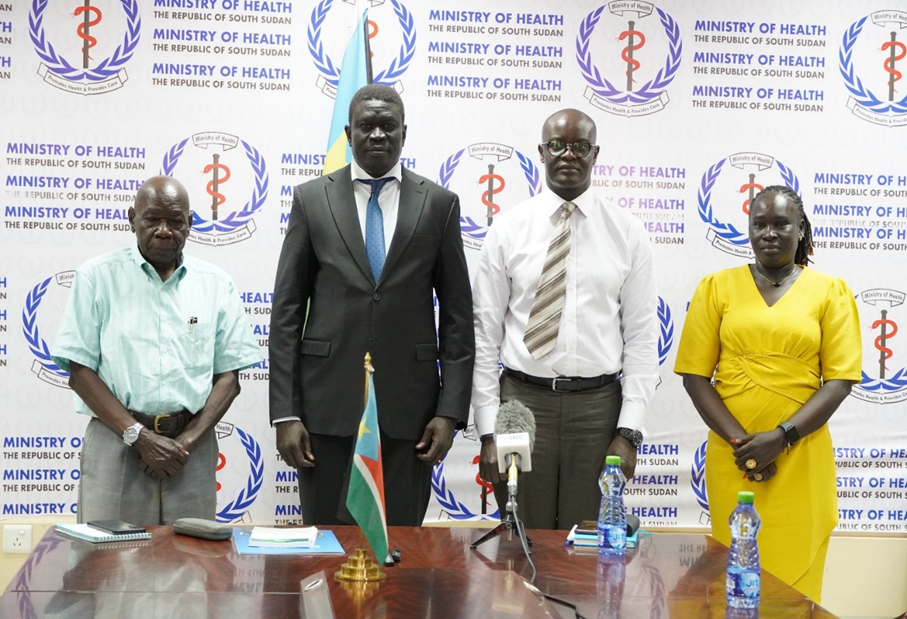
A group photo taken after a press conference at the Ministry of Health on July 28th 2026/ by Ezekiel Idris
By Awuou Michael
South Sudan has increased its national Ebola preparedness capacity to 65 percent in July, up from 45 percent in June and 29 percent in May, as health authorities intensify measures to prevent the importation of the virus from the neighboring Democratic Republic of Congo (DRC).
The improvement comes as the Ministry of Health reaffirmed that the country has not recorded any confirmed Ebola Virus Disease (EVD) or Bundibugyo Virus Disease (BVD) cases, despite the heightened risk posed by ongoing transmission in eastern DRC.
While addressing the Media, the acting Undersecretary in the Ministry of Health, Dr Michael Mading, said the government has strengthened preparedness in line with the National Health Emergency Preparedness and Response Plan and the International Health Regulations (2005), working closely with the World Health Organization (WHO), United Nations agencies and other health partners.
“South Sudan has not detected any confirmed case of Ebola Virus Disease. The preparedness measures currently being implemented are precautionary and should not be interpreted as evidence of active transmission within the country,” the Ministry said.
He explained that screening has been intensified at the major border entry points of Nimule, Kaya, Yei River County, Olikwi and Juba, while surveillance has been strengthened across 15 counties bordering the DRC and Uganda to ensure early detection of any suspected cases.
“Cross-border screening has been intensified at priority points of entry, and surveillance has been enhanced in border counties to strengthen early detection and rapid response,” the statement added.
Dr. Mading said county surveillance officers continue to submit daily zero reports, while rapid response teams remain on standby to investigate alerts and contain any suspected cases. The Ministry noted that 13 suspected Ebola cases identified through active surveillance and border screening have all tested negative.
Meanwhile, the World Health Organization Health Development Team Leader, Moses Ongom, said the country’s preparedness has improved steadily over the past three months despite the continuing regional threat.
“Our national readiness has increased from 29 percent in May to 45 percent in June and now stands at 65 percent in July. This reflects significant progress in strengthening surveillance, laboratory capacity, coordination and rapid response mechanisms,” Ongom said.
He noted that South Sudan remains at high risk of Ebola importation because of its shared border with the DRC, where transmission continues.
“Although South Sudan remains at high risk of importing Ebola due to ongoing transmission in the Democratic Republic of Congo, the country has made remarkable progress in building the capacity needed to detect and respond to any suspected case,” he said.
Dr. Ongom added that WHO continues to support the Ministry of Health in strengthening preparedness while promoting public awareness through risk communication and community engagement.
“Risk communication and community engagement remain essential in ensuring that communities receive accurate information, reject misinformation and adopt preventive measures that help keep South Sudan free of Ebola,” he said.
The Ministry of Health and WHO have urged the public to remain vigilant, report any suspected symptoms promptly and cooperate with health authorities as the country continues efforts to maintain its Ebola-free status.
Bundibugyo virus is a severe strain of the Ebola virus (family Filoviridae) that causes viral hemorrhagic fever, presenting symptoms such as fever, severe headache, and bleeding.
Leave a Reply